
DealSafe.ai Product, brand & website
DealSafe.ai
From an founder’s idea to a guided private car sale, researched and prototyped in three months.
- Role
- Product design lead
- Research
- 12 participant interviews
- Scope
- Research, UX, brand, design system & app
- Timeline
- 3 months, from idea to team MVP
The overview
The founder reached out to me to turn his idea for DealSafe into a safer way for people in South Africa to buy and sell cars privately. My responsibility was to turn that ambition into a product people could understand, use and feel confident in, then help the developers take it into an MVP.
The goal
Give both people a clear answer to three questions: Who am I dealing with? Where is my money? What happens next? The intended experience holds funds until the agreed handover conditions are met and both sides are ready to proceed.
My contribution
I led the work from interviews and competitor analysis through personas, separate buyer and seller journeys, wireflows and product architecture. I created the brand and design system, built the working app prototype and marketing website, tested with real users, and supported the developers building the MVP. I used AI to significantly fast-track my workflow, taking the work from research through design and prototyping within three months.

Start with the people taking the risk.
I interviewed 12 participants about buying and selling cars. A recurring need was education: help understanding the process, the technical details and what to look out for before making a decision. People wanted guidance they could use while moving through a sale.
Women’s personal safety concerns were particularly important. Interviews also surfaced reliance on men for guidance through the technicalities of buying or selling. I treated that as a need for greater independence and confidence, with clear explanations and more reassurance about the person on the other side.
Money added another layer of uncertainty. Participants wanted transparency about costs, where their money was going and who was accountable. An established dealer could feel safer because there was somewhere to return and at least try to recover their money. That was a perception of recourse, not a guarantee.
Turn those concerns into product decisions.
I used the interview themes to shape the product around guidance, identity and visible progress. Technical requirements needed a plain-language explanation. Verification needed to explain who had been checked. Payment needed distinct states for an offer, secured funds and release.
The central design principle became a shared understanding before commitment. Buyers need confidence in the vehicle and seller; sellers need confidence in the buyer and payment. I translated that into guided steps, a shared deal room and explicit handover confirmation.
Explore the work
Look beyond another listings marketplace.
I mapped local and international competitors across classifieds, dealer-offer platforms and managed retailers. The comparison helped me examine how each model builds trust, explains pricing and takes responsibility for the transaction.
I brought that analysis back to the interviews. The opportunity was to support the private transaction itself: knowing the counterparty, understanding the money flow and agreeing when the deal can move forward. I used that focus to shape the MVP rather than treating every competitor feature as a requirement.
The comparison records the research at the time of the project; it is not a live assessment of competitors’ current services.
Two perspectives. One connected transaction.
I created preliminary buyer and seller personas to make different needs visible, then mapped each role’s journey separately. The buyer needs to evaluate a car and commit a large payment. The seller needs to establish ownership, manage offers and know when it is safe to hand over the vehicle.
I connected the journeys across identification, vehicle information, matching, escrow and settlement. Mapping both sides exposed the dependencies: what one person must complete before the other can act, and where verification failures, finance settlement or a disputed handover need a different route.
The persona board explicitly labels these profiles as hypotheses. The interview themes are research findings; the fictional profiles are a separate design aid.
Make the decisions visible in wireflows.
I translated the journeys into mobile and desktop wireflows, connecting screens to actions and decisions. This made it possible to discuss the experience before investing in detailed UI: what someone sees, what they need to understand and what allows them to continue.
The flows also helped me sculpt the product with the founder. I could make the MVP scope concrete, trace the critical transaction path and identify the less straightforward states that development would need to support. The boards document exploration as well as decisions; the working prototype shows how the experience evolved.
Direct the AI. Own the judgement.
My AI-assisted workflow connected research, analysis and making. I used AI to help organise the research themes, explore UX directions and develop the flows. I reviewed those outputs against the interviews and the product intent, deciding what to keep, reshape or leave out.
From there, I scaffolded the product architecture and moved into the brand, design system and working app. Claude Code, Cursor and Codex helped with implementation and iteration. My role was to set the structure, connect the parts and inspect the resulting experience, rather than treat generated output as a finished design.
The advantage was a shorter distance between an insight and something we could try. I could take a question from the research into a flow, make it work in the prototype, test it with people and bring a concrete decision back to the founder and developers.
Build a prototype people can actually use.
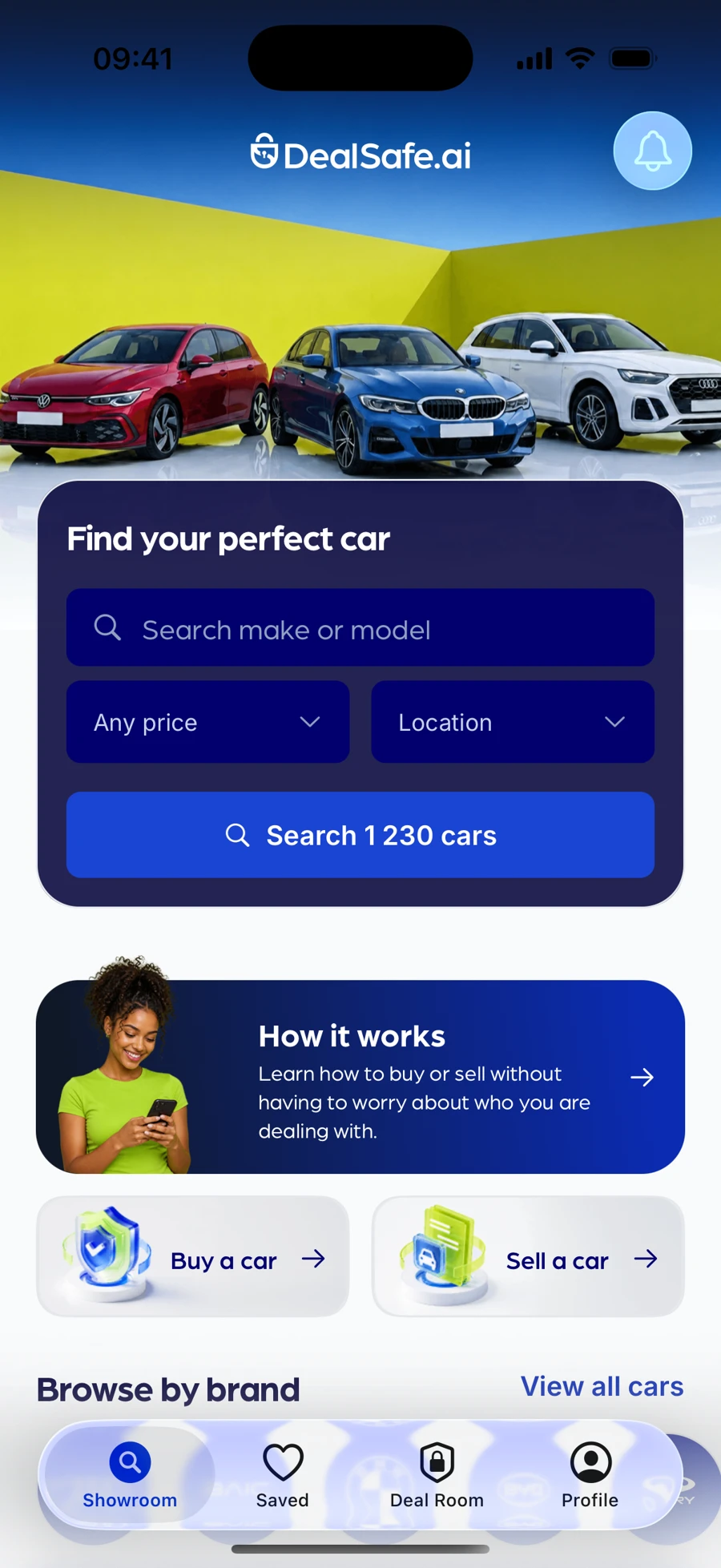
I built the Expo prototype as a working app, bringing navigation, vehicle discovery, verification and the deal room together. That made the intended behaviour tangible for the founder and gave me an experience to put in front of real users.
I tested the prototype with real users and used their feedback to refine the experience while supporting the developers building the MVP. The working app became a shared reference for the intended interactions and transaction states, alongside the journeys, wireflows and design system.
The recording uses sample vehicles and transaction states. The prototype demonstrates the intended experience, not a live escrow transaction.
Give trust a recognisable identity.
I created a brand that could bring reassurance to a serious transaction without feeling intimidating. The lock-and-shield mark anchors the identity; blue and lime give it a distinctive presence across the app and website.
Arboria and Inter establish the typographic voice. Architectural vehicle photography, patterns and three-dimensional illustrations extend the identity into product explanations and communications. I carried these choices into the design system so the brand could survive the move from presentation to working software.
Connect the system to the build.
I created the cross-platform design system, Expo prototype, documentation site and native component showcase in a focused week within the wider three-month project. Shared foundations connected Figma decisions with web, iOS and Android implementations.
I also designed and built the complete marketing website in Codex. Its structure gives people room to understand the proposition, how the process works, escrow, pricing and common questions before entering the product.
I supported the developers as they built the MVP, using the prototype and documented flows to communicate intent and work through implementation questions. The outcome depended on the team’s development work as well as the foundations I created.
Where it landed.
In three months, I helped the founder move from an idea to a research-led product direction, a distinct brand, a cross-platform design system and a working app prototype tested with real users. I supported the developers in taking those foundations into the team’s MVP. The work demonstrates how I combine experienced product judgement with AI-assisted execution across research, design and build.
Explore the DealSafe design systemExplore the work

